







The Tiny Discovery That Becomes A Traffic Jam
It starts with a single ant.
You notice it wandering across the kitchen worktop.
A few minutes later, there are two.
Then five.
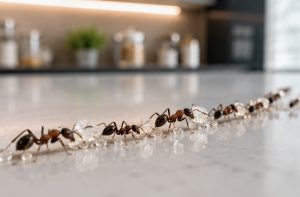
Then suddenly, an organised line of ants seems to have appeared from nowhere.
Most people have experienced it.
One day the kitchen is completely clear.
The next, dozens of ants seem to know exactly where the sugar, crumbs, or pet food are located.
How do they do it?
And why do ants always seem to find food so quickly?
The answer lies in one of the most sophisticated communication systems in the natural world.
Ants Are Constantly Searching
Ant colonies rely on worker ants to explore their surroundings.
These workers leave the nest and search for food, water, and other resources.
Most of the time, they find nothing.
But occasionally, one ant discovers something valuable.
A dropped biscuit crumb.
A sugary drink spill.
A pet food bowl.
Or a forgotten packet left slightly open.
That single discovery can change everything.
Fun Fact #1
Some ant colonies contain thousands of workers.
Others may contain hundreds of thousands.
Every worker plays a role in helping the colony survive.
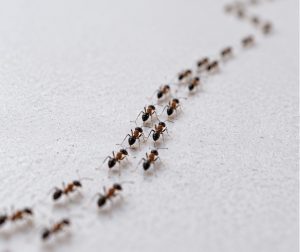
The Secret Is An Invisible Trail
When an ant finds food, it does something remarkable.
As it returns to the colony, it leaves behind an invisible chemical trail.
This trail contains substances known as pheromones.
Other ants can detect these chemical signals using their antennae.
The stronger the trail, the easier it becomes to follow.
What begins as one ant quickly becomes many.
Why The Trail Gets Stronger
The process does not stop with a single ant.
Every time another ant follows the route, it reinforces the pheromone trail.
The more successful the food source, the stronger the trail becomes.
This creates the organised lines of ants that homeowners often see moving across patios, driveways, kitchens, and garden paths.
To us, it looks coordinated.
To the ants, it is simply communication.
Fun Fact #2
Ants do not need maps.
Many species rely heavily on pheromone trails to navigate between food sources and the colony.
Why Sugar Is So Popular
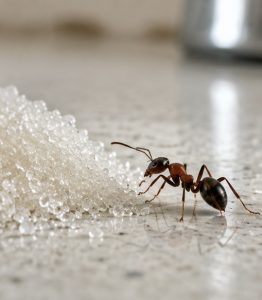
Many ant species are attracted to sweet foods because sugar provides energy.
That is why ants frequently appear around:
- Sugar bowls
- Soft drink spills
- Fruit
- Sweet foods
- Pet food
- Food crumbs
A tiny amount of food that goes unnoticed by humans can represent a valuable resource for an entire colony.
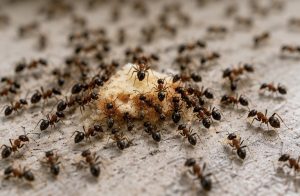
The Bigger Story Happening On Your Kitchen Floor
What appears to be a simple ant problem is actually an example of collective intelligence.
No single ant is in charge.
No ant is directing traffic.
Yet thousands of individuals can work together to solve problems, locate resources, and adapt to changing conditions.
Scientists have spent decades studying ant colonies because of their remarkable ability to organise themselves efficiently.
Fun Fact #3
Some ant colonies create living bridges using their own bodies, allowing other ants to cross obstacles and continue searching for food.
Why Ant Activity Increases During Warmer Months
As temperatures rise, ant colonies become more active.
Worker ants spend more time searching for food and water.
This is one reason homeowners across South London often notice increased activity during spring and summer.
Gardens, patios, kitchens, and outdoor eating areas become particularly attractive locations.
What This Means For South London Homeowners
South London’s combination of gardens, family homes, parks, and outdoor spaces provides ideal environments for many ant species.
The challenge is not usually the first ant.
It is what the first ant represents.
Because where one ant appears, many more may soon follow.
Understanding how ants communicate helps explain why activity can seem to increase so quickly.
The Bigger Lesson
Perhaps the most fascinating thing about ants is not their size.
It is their ability to work together.
The organised trails seen across kitchen floors and garden paths are not random.
They are part of a highly effective communication system that has evolved over millions of years.
The next time you see an ant carrying a crumb across your kitchen floor, remember:
You are not just watching an insect.
You are watching one small part of an extraordinary colony at work.
Learn More
Visit www.veritexpestcontrol.com to explore more insights into pest behaviour, modern research, and the fascinating science shaping pest management across South London.